
Health
Brief Summary
The Black Russian Terrier is in general a healthy breed and lives between 9-14 years. Like any pedigree dog they can be prone to some health problems. But by purchasing your dog from a reputable breeder which health tests and makes sure they are breeding healthy dogs. A good breeder will be able to show you DNA test results for JLPP and HUU, PRA-prcd, Hip and Elbow Scores. Eye and Heart Certificates of both Dam and Sire. If a breeder will not show you these it should be a red flag and you should find another breeder to purchase your pup from.

DNA Tests
DNA tests are available for Hyperuricosuria and Hyperuricemia or Urolithiasis (HUU), Juvenile Laryngeal Paralysis and Polyneuropathy (JLPP) and Progressive Retinal Atrophy – progressive rod-cone degeneration (PRA-prcd). These are all hereditary genetic conditions that are known to be present in the Russian Black Terrier and that are caused by the presence of a mutated gene related to the condition that is autosomal recessive in nature.
Since genes come in pairs, an autosomal recessive disorder requires that two copies of the abnormal gene – one copy inherited from each parent – must be present in order for an offspring to be affected by the condition. Parents who have one normal gene and one mutated gene are known as carriers, are not affected by the condition, but can pass the condition on to their offspring. Parents with two normal copies of the gene are known as clears, are not affected by the condition and cannot pass it on to their offspring.
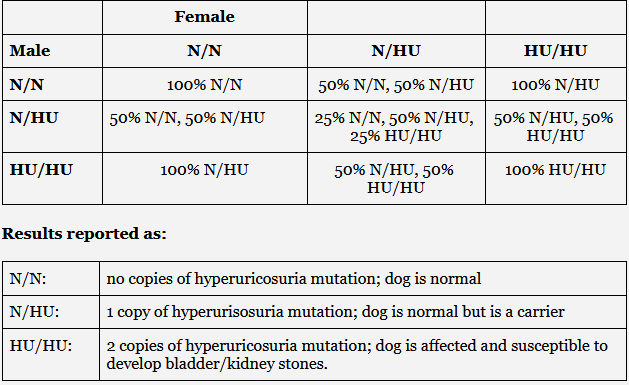
The possible mating combinations and their results are shown in the following chart:
Breed Specific Illnesses
Hyperuricosuria (HUU)
Hyperuricosuria (HUU) is a genetic condition of excessive uric acid in the Black Russian Terrier resulting in stones being developed in the kidneys or bladder. It is difficult to treat and the removal of the stones is done by surgical intervention.
1. All breeding dogs should be tested to determine their HU status (N/N, N/HU, or HU/HU). Knowing the HU status of the parents will give you an idea of the likelihood of the puppy having HU. If either of the parents is normal (N/N), then you will know that none of the puppies will be affected with this disease. If affected (HU/HU) or carrier (N/HU) dogs are bred to each other, a certain percentage of the puppies can be expected to be affected with HU.
2. The HU test is a cheek swab test and can be done at any age. It is possible that the puppies could be tested before being sold/purchased. It is prudent to ask what the HU status of the parent dogs is to help determine if HU is expected to be present in the puppies.
3. Through selective breeding, producing HU-affected puppies can be avoided. Be sure to know the status of the puppy prior to purchasing and any guarantees the breeder may give regarding HU if the status is not known when the puppy is purchased. Purchasing a puppy of unknown HU status is discouraged. While this disease is treatable, it requires effort and expense for the owner to control. Knowing that HU can be prevented through breeding, BRT breeders have an obligation to inform a puppy purchaser if the puppy is affected by or may be affected by HU. If a breeder will not disclose the HU status of the parent dogs and puppies (if available), we recommend looking elsewhere for a puppy.
Dogs suffering from HU lack the capability to effectively metabolize protein within their bodies. Typically, the final product of protein metabolism is allantoin, which is soluble and eliminated through urine. In a BRT that is affected, the transformation of uric acid into allantoin is compromised. Consequently, the dog excretes uric acid in its urine. Uric acid does not dissolve easily in urine and tends to crystallize as urate. These crystals can lead to complications. In certain dogs, these crystals may irritate the bladder wall, resulting in inflammation known as cystitis.
A dog with cystitis often exhibits signs of discomfort during urination. They may experience straining and urinate frequently, often producing only a small volume of urine. The urine may also appear blood-tinged. Additionally, the bladder may become significantly thickened. Such dogs frequently lick their genital area, which is often incorrectly diagnosed as a urinary tract infection. At times, urate crystals can cluster together to form solid urate stones. When this occurs, the stones can develop anywhere within the urinary tract, with the bladder being the most prevalent location. Occasionally, the stones are small enough to be expelled in the urine. An owner might notice grit or small stones while cleaning up after an accident. In male animals, the expulsion of stones also presents a risk of urinary blockage. The male dog has a constriction in the urethra at the os penis, which is the bony structure found in the penis. Since the urethra passes through a bony tunnel, it cannot expand. This can result in a blockage at the base of the penis, making it difficult or impossible for urine to pass. The dog may strain to urinate, often only managing to pass a few bloody drops. This situation constitutes a genuine emergency, and if it arises, it is crucial to have your dog examined by a veterinarian immediately. At the veterinary clinic, a urinalysis may detect urate crystals, heightening the suspicion of HU. Radiographs can reveal stones in the bladder or urethra; however, urate stones are not always radio-dense and may not be visible without the use of contrast media.
Emergency treatment focuses on clearing the urethra and restoring urine flow. In some cases, a catheter may be utilized to push stones back into the bladder, facilitating their retrieval through cystotomy. However, if the stones cannot be flushed, a urethrostomy, which involves making an incision over the stones in the urethra, may be necessary. Should the dog persist in developing stones, a permanent urethrostomy might be recommended to create an opening large enough for the passage of any stones produced. This procedure is highly invasive, permanently altering the dog’s anatomy, and carries a significant risk of complications.
Currently, there is no cure for HU, but certain measures can help minimize the risk of crystal or stone formation. A dog affected by HU will always be susceptible to developing urate crystals or stones; however, specific strategies can be employed to lower the likelihood of this occurrence. Since uric acid results from purine metabolism, it is crucial to maintain a diet low in purines. Information regarding the purine content of various foods is readily available. Generally, it is advisable to avoid red meats, organ meats, and certain fish, such as sardines and mackerel. Instead, eggs, cheese, and white meats like chicken can provide a good source of low purine protein. Nonetheless, it is vital to ensure that your dog receives a balanced diet, so consulting a veterinary nutritionist is recommended if you are contemplating a home-prepared diet. Additionally, several veterinary diets are available that are specifically formulated to reduce or eliminate urate stones. Producing dilute urine is of utmost importance! When urine is diluted, it becomes significantly more challenging for urate crystals to gather and form stones. Enhancing water intake by soaking food in warm water can substantially decrease the likelihood of cystitis or urate stone formation. In fact, increasing water consumption to dilute urine is the most critical strategy for preventing the formation of urinary stones.

Content Creation
Tell your visitor how your service can improve their life. Connect with the problem that they’re trying to solve and address any objections you think they might have.
What is the biggest benefit your customer will get from this? Keep your target audience in mind.